Revenue Operations Simulation

Teach Revenue Operations
the way founders live it.

The Octearn RevOps Simulation puts your students inside a live commercial environment — a team of up to 10 takes C-suite roles and runs a seed-stage SaaS company for 12 quarters. They allocate real budgets, defend their reasoning in a Decision Journal, and navigate market events you inject from the Timeline. Every team ends with a Credential Tier and a grade on the why, not just the what.

12 quarters · 5 C-suite roles · Up to 200 students per cohort
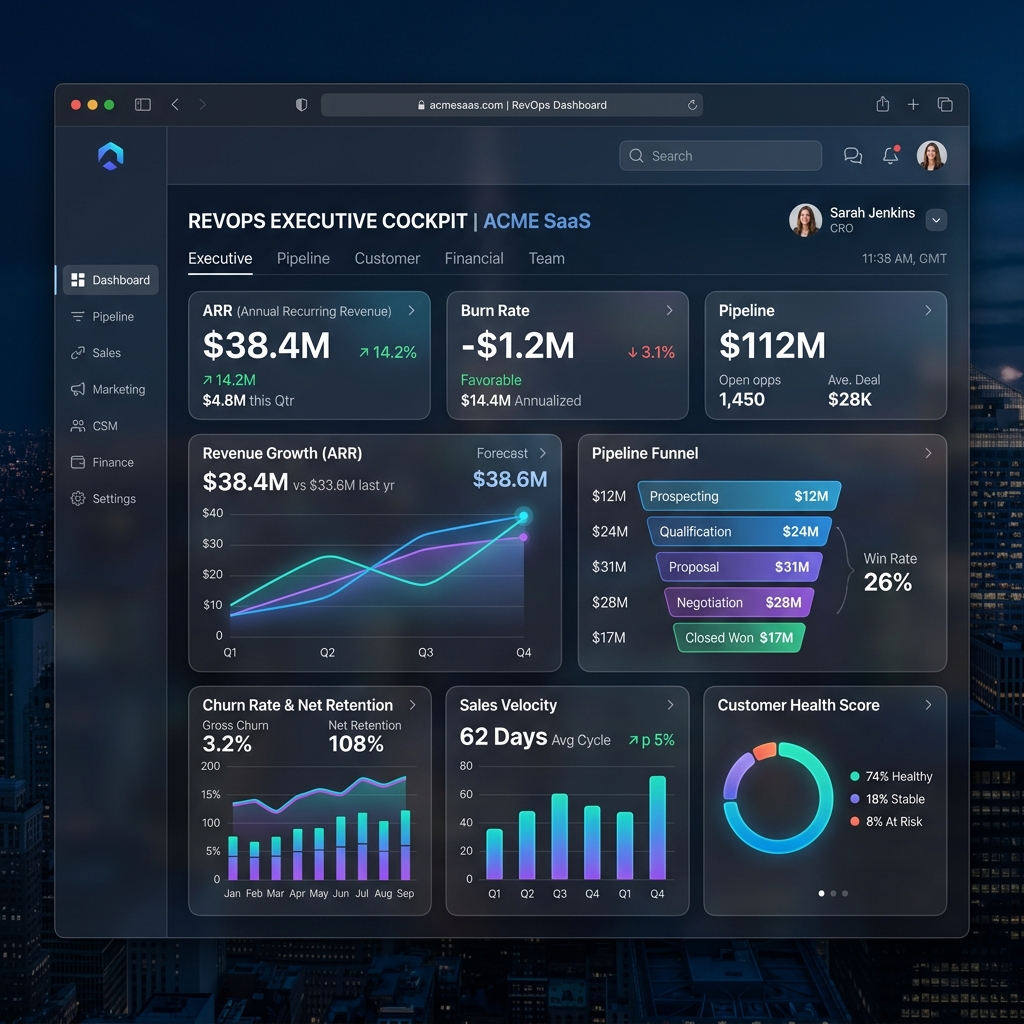
Octearn RevOps Simulation — executive cockpit with live ARR, Pipeline, Burn Rate and Revenue Growth metrics
12 quarters
3 simulated years per run
5 roles
CRO · CMO · CSO · CCSO · CFO
4 tiers
Operator · Architect · Strategist · Unicorn
100+
students per cohort supported

Your students can draw a funnel.
They've never been inside one that's breaking.

Case studies are post-mortems. By the time the HBS case hits the classroom, the founder has already made the decision, survived the quarter, and told the tidy version of the story. Your students learn the answer. They never learn the judgment.

Revenue Operations is a judgment discipline. It's pipeline hygiene when the board asks why close rates fell. It's budget reallocation when a competitor raises $50M on a Tuesday afternoon. It's the commercial decisions a founder makes with incomplete information and a clock ticking.

The Octearn RevOps Simulation is a live board. Your students take the seat. Competitor moves fire mid-round. Metrics shift in real time. Every decision is logged, scored, and debriefed.

That's not a case study. That's rehearsal.

“My students argue about pipeline calls like they’re defending a thesis. That’s never happened with a case study.”
— Associate Professor, European Business School

A live commercial environment —
tuned to the decisions that actually matter.

Every round, students see the board the way a founder sees it: ARR, pipeline coverage, burn, runway, headcount. Levers on the left. Consequences on the right. No simulation jargon — just the numbers their future CFO is going to ask about.

ARR & Pipeline

Track Annual Recurring Revenue, Net Revenue Retention, and win-rate shifts quarter over quarter. Every hire, every CRM purchase, every enterprise deal lands on the board.

Burn & Runway

Each quarter the C-suite allocates across Ad Spend, Sales Reps, CS Reps, and Tech Stack. Hiring accelerates growth and accelerates burn. Hit $0 and the game is over.

Market Events

You inject them. A Competitor Launch hits win rates by -20%. A Macroeconomic Downturn drops pipeline velocity. Timed from the instructor Game Timeline — teams have one quarter to adapt.

Quarterly Reports

Every quarter resolves into a report that exposes where the model broke down. Every decision, every metric, every Decision Journal entry — logged. The debrief writes itself.

Twelve quarters take a cohort from a $2M seed round to a board-ready scale-up. You control the pace — resolve each quarter when you're ready, inject market events from the Game Timeline, and debrief from the facilitator command centre.

12 quarters. 5 C-suite roles.
A valuation tier for every team.

1
Set-up

Assign the C-suite

Create a Batch in the instructor dashboard and drag students into companies of up to 10. Each team member gets a specific role: CRO, CMO, CSO, CCSO, or CFO. Every company starts with $2M raised, $100K ARR, and 8 customers.

2
12 quarters

Play

Each quarter the C-suite submits a synchronized budget across Ad Spend, Sales Reps, CS Reps, and Tech Stack. Every call is logged to the role that made it. Every rationale is captured in the Decision Journal before decisions lock.

3
You control pacing

Resolve & disrupt

Click Resolve Quarter when every team has locked. The engine calculates the outcome, updates ARR, NRR, and LTV:CAC, and advances the clock. Inject a Competitor Launch or Macroeconomic Downturn from the Timeline when you want to stress-test a dominant strategy.

4
End of run

Tier & debrief

After Q12 the engine ranks each team: Operator, Architect, Strategist, or Unicorn CRO, based on final valuation, LTV:CAC, and capital efficiency. You grade the Decision Journal for reasoning. Financial scoring is instant; reasoning is yours.

A valuation tier for every team.
A reasoning grade for every decision.

At the end of 12 quarters the engine ranks every team on the financial outcome it actually produced. You, the instructor, grade the reasoning behind how they got there. Objective numbers plus instructor judgment — the same split a real board uses.

Final Valuation Tier

Every team lands in one of four tiers based on final company valuation, ARR growth, and capital efficiency: Operator, Architect, Strategist, or Unicorn CRO. Calculated automatically from the engine.

LTV:CAC Ratio

Did they acquire customers profitably, or just burn cash to grow? The engine tracks Lifetime Value against Customer Acquisition Cost across all 12 quarters — the metric real investors look at first.

Decision Journal

Every major call — CRM purchase in Q3, Sales hiring in Q7 — is logged with the team's reasoning before decisions lock. You grade the why. The engine never touches this field.

Role Accountability

Every decision is stamped with the C-suite role that made it. The CRO signs off, the CFO runs burn, the CSO owns the sales plan — you can grade each student on the calls their role actually controlled.

Engine-grades the outcome. You grade the reasoning. Hand the resulting report to your programme director as evidence the module is doing what the syllabus claims.

This isn't a quiz with a timer.
It's the cockpit of a company.

Every student gets a live commercial environment — real dashboards, real channels, real consequences. Here's what they see from Round 1.

Executive Dashboard

Live KPI cards — ARR, pipeline coverage, burn rate, runway — updating in real time. Revenue waterfall charts and quarterly comparisons. The same view a real CRO sees on Monday morning.

Scenario Builder

A what-if simulator. Students test budget reallocations before committing — see the projected impact on pipeline, burn, and runway instantly. Then decide under pressure whether to pull the trigger.

JRP Negotiation

Joint Revenue Planning — cross-functional trade-offs between Sales, Marketing, CS, and Product. Students negotiate resource allocation the way a real leadership team does: with competing priorities and a shared number.

Batch Chat

Three real-time channels — strategy, operations, and general. Teams communicate, debate, and coordinate under time pressure. Every message is logged for debrief. No hiding behind silence.

Market News Feed

Breaking events fire mid-round with severity tags — a competitor raises $50M, a key customer churns, a regulatory shift hits. Students have minutes to read, interpret, and respond. No advance warning.

Concept Glossary

30+ business terms — ARR, NRR, CAC, LTV, pipeline velocity — each linked to live calculations from the student's own company data. They don't just learn definitions. They see the math in motion.

Leaderboard & Badges

Real-time team rankings with achievement badges for standout decisions. Four credential tiers: Operator, Architect, Strategist, Unicorn CRO. Competition drives engagement. Engagement drives learning.

Crisis Response Room

When a major event fires, the Crisis Room activates — compressed timers, elevated stakes, team-wide alerts. Students experience what a real war room feels like. Hesitation is visible. Conviction is scored.

You're not watching a recording.
You're running the board.

The Instructor Workspace gives you real-time control over every dimension of the simulation — pace, pressure, events, and visibility. Here's what you see.

Spy Mode

Observe any team's live decisions, chat messages, and reasoning in real time — without them knowing. See who's leading, who's hesitating, and where the coaching opportunity is. Switch teams with one click.

Market Event Injector

10 preset events plus custom event creation. Each event carries multipliers for pipeline, CAC, and churn. Inject a competitor funding round mid-round and watch how teams reallocate in real time.

Progress Heatmap

See every team's advancement at a glance — colour-coded by performance, submission status, and decision speed. Know who's stuck, who's thriving, and who needs a nudge — before they ask.

Invite Wizard & Magic Links

Three-step onboarding: upload a CSV, assign roles (CRO, CMO, CSO, CCSO, CFO + VP), send magic links. No passwords. No IT tickets. Students click one link and they're in the simulation.

Facilitator Approval Workflow

Gate strategic decisions — large budget shifts, major hires, market pivots — behind facilitator approval. Use it as a coaching moment: ask the team to justify their call before it goes live.

Demo Playground

A pre-seeded sandbox with sample data for walkthroughs and training. Show a dean, a programme director, or a new facilitator exactly what the simulation looks like — without needing live participants.

Achievement Badges

Auto-generated and custom badges for standout team performance — fastest decision, highest adaptability, best rationale. Gamification that reinforces the learning outcomes you care about.

Comparative Analytics

Side-by-side cohort comparisons, radar charts for every team, round-by-round score progression. Export the full after-action report as a PDF. The debrief writes itself.

You don't need to redesign the syllabus.
You need to give students a rehearsal.

The RevOps Simulation slots into the courses management lecturers already deliver — from undergraduate to MBA to exec ed. One platform. Three teaching postures.

MBA & Masters

Replace the case study with the cockpit

MBA students read the HBS case, then live their own. Run the full 12-quarter cohort across a half-semester module — one quarter per class, or multiple quarters per session if you want to push the pace. You get a final Valuation Tier and a Decision Journal grade for every student to enter in your gradebook. The quarterly replay is the discussion.

Strategy · Entrepreneurship 12 quarters Half-semester

Outcome: Valuation Tier + Decision Journal grade feed directly into individual assessment. No rubric to build from scratch.

Executive Education

Give senior leaders a mirror, not a lecture

Two-day exec ed programmes compress 12 quarters into a sequence of timed live rounds. Senior leaders experience what three years of C-suite trade-offs actually feel like — then debrief their own pattern of decisions against the final tier. The data changes the coaching conversation.

Leadership · CRO Programmes Compressed format 2-day intensive

Outcome: End-of-run reports give exec ed buyers the measurable outcome they've always struggled to demonstrate.

Undergraduate & BBA

Give graduates commercial exposure before they start applying

Final-year business students run a SaaS company for 12 quarters as part of a C-suite team — instead of reading about one. The end-of-run Credential Certificate reflects the tier they reached (Operator → Unicorn), giving them something tangible to share with recruiters: proof they've made real commercial decisions under pressure.

Strategy · Business Fundamentals 12 quarters Capstone or seminar

Outcome: Credential Certificate + instructor-graded Decision Journal — documented evidence of applied commercial judgment.

Want to run this yourself? Get certified.

Lecturers, exec ed directors, and independent facilitators can earn the Octearn credential to deliver the RevOps Simulation at scale. Three-tier pathway, cohort-based, invitation to Pro and Strategic tiers.

Your students have been studying the answers.
Give them a rehearsal with the question.

The RevOps Simulation replaces a static case study with a live cockpit. Student teams of up to 10 take C-suite and VP roles (CRO, CMO, CSO, CCSO, CFO) and run a seed-stage SaaS company for 12 quarters — allocating Ad Spend, Sales and CS headcount, and Tech Stack investments. The engine grades the financial outcome automatically. You grade the Decision Journal. One session produces a mid-term, a final, and a debrief.

Role-based team architecture

Drag-and-drop Team Builder assigns every student a specific C-suite role. Decisions are stamped with the role that made them, so you can grade each student on what their seat actually controlled.

Accreditation-ready evidence

Every run produces a per-team end-of-simulation report — final valuation, LTV:CAC, Decision Journal entries, and tier. Maps cleanly to AACSB, ACBSP and EQUIS learning outcomes for applied commercial decision-making.

Credential Certificate per tier

Teams that reach Operator, Architect, Strategist, or Unicorn CRO receive a Credential Certificate reflecting that tier — something verifiable their students can share with recruiters beyond a course grade.

Everything you need to know.

How do I see the RevOps Simulation before committing?
Book a demo — we run a live session with you playing a C-suite role while we facilitate. You experience a real quarter end-to-end, see the board resolve, and walk through a Decision Journal review. Most lecturers make their decision in that one call. No commitment.
What is the RevOps Simulation?
A facilitator-led, real-time multiplayer simulation where student teams of up to 10 take C-suite and VP roles (CRO, CMO, CSO, CCSO, CFO) and run a seed-stage SaaS company for 12 simulated quarters. Each quarter, the team submits a synchronized budget across Ad Spend, Sales Reps, CS Reps, and Tech Stack — with a Decision Journal entry capturing the reasoning behind each call.
How many students can join a session?
Each Batch supports up to 200 students organised into companies of up to 10, each with an assigned C-suite role. The instructor controls the pace — teams lock their decisions, you click Resolve Quarter, the engine resolves, and the clock advances.
How long does a full 12-quarter run take?
Most lecturers spread a full run across a module — one or two quarters per class across a half-semester — so each quarter can be properly debriefed. Exec-ed programmes compress the 12 quarters into a two-day intensive with tighter timers. There is no automatic clock: the instructor resolves each quarter when the cohort is ready.
How are teams graded?
Two layers. The engine ranks every team at the end of Q12 into a Credential Tier — Operator, Architect, Strategist, or Unicorn CRO — based on final valuation, ARR growth, NRR, and LTV:CAC. The instructor grades the Decision Journal for reasoning. Financial outcomes are objective. Judgment is yours.
Can I throw curveballs at the cohort?
Yes. The Game Timeline lets you schedule or inject market events — a Competitor Launch that drops win rates by -20%, a Macroeconomic Downturn that cuts pipeline velocity, or custom events you configure. If a dominant strategy emerges, you disrupt it. This is where strategic judgment is forged.
Does it integrate with our LMS?
No LMS integration is needed. Students join with a magic link on any device, and there is nothing to install in Canvas, Blackboard or Moodle. End-of-run reports and Decision Journal grades are exported as PDF for you to enter in your gradebook.
Do I need technical setup?
No. The simulation runs entirely in the browser. Students join on any device via magic link — no downloads, no passwords, no IT tickets. The Invite Wizard onboards a whole cohort from a CSV in minutes.
How does Octearn Academy certification work?
Octearn Academy offers a three-tier certification pathway for facilitators who want to run the simulation independently. Foundation (free), Pro, and Strategic levels — each earned on demonstrated competence. Request Access →

Your students deserve a rehearsal,
not just a reading list.

Book a demo and play a live quarter of the RevOps Simulation — you take a C-suite seat while we facilitate. Watch the engine resolve, review the Decision Journal, and see exactly what your cohort will experience across 12 quarters.

12 quarters · 5 C-suite roles · Up to 200 students per cohort